
DATA TALE · CLIMATE RISK
Translating physical climate risk into verifiable banking decisions
Multiple property locations become traceable climate-risk assessments — with hazard logic, financial risk metrics and documented model assumptions.
External content
app.lularge.com
This content is loaded from an external provider. Doing so transmits your IP address to them. Nothing is requested until you choose to load it.
§01 · SITUATION
The starting point
Banks increasingly have to place physical climate risk within ICAAP, risk management, Pillar 3 disclosure and ESG reporting.
For real-estate and loan portfolios in particular, a purely qualitative description is no longer enough. What is needed is traceable data, documented assumptions and robust assessment logic.
For alpine and regionally complex locations this creates a structural problem: hazards such as flooding, heavy rainfall, landslides, local inundation, heat or drought are often represented only coarsely, or in a way that is hard to verify, in generic models.
It becomes harder still when physical risk indicators are not translated into financial decision metrics. For risk controlling, management, internal audit and supervisors, what matters is not only whether a location is exposed, but what monetary significance that risk can carry.
§02 · WHAT WE BUILT
An auditable assessment workflow for physical climate risk
We ran several property locations through a structured ICAAP Climate Physical Risk Assessment workflow.
The workflow combines location data, asset-level value assumptions, several climate and geospatial data sources, and hazard-specific assessment logic.
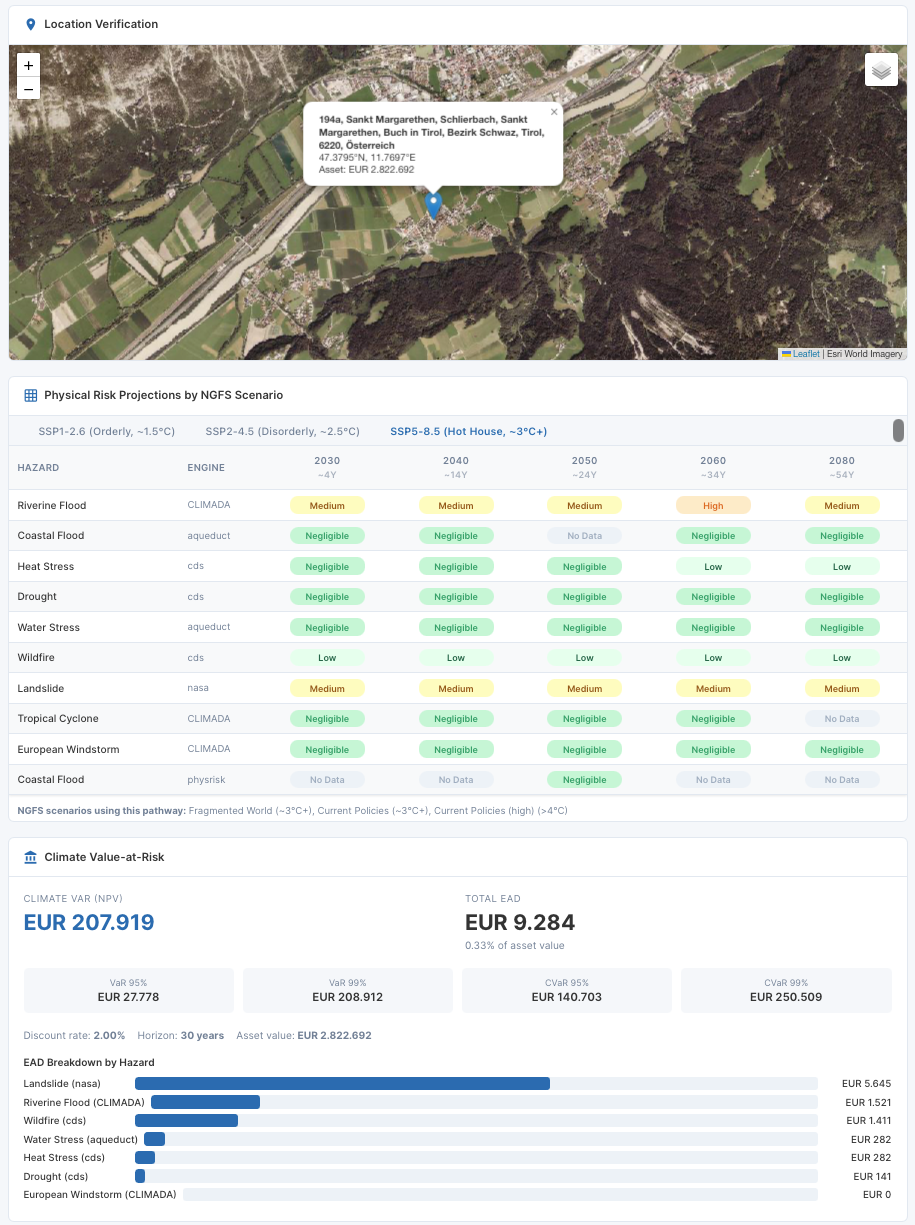
Each hazard is assessed through an appropriate analysis path. Results are not only output as a risk class, but presented together with raw indicators, financial metrics and methodological assumptions.
This turns fragmented climate, geospatial and risk data into an auditable assessment logic that translates physical hazards into monetary risk measures.
- Location-based assessment of physical risk across several property sites
- Hazard routing through specialised analysis paths for flooding, water stress, wind, heat, drought, wildfire and landslides
- Translation of physical risk indicators into EAD, VaR, CVaR and discounted expected loss values
- Presentation of the underlying raw indicators for each hazard
- Linkage of hazard exposure, asset value assumptions and financial risk metrics
- A downloadable report as an auditable artefact for further expert assessment
§03 · BUSINESS VALUE
Business value
The workflow creates a prepared decision basis for organisations that must not only be aware of physical climate risk, but explain it internally and process it further.
For banks, what matters most is that physical hazards do not stop at abstract indicators. The workflow translates them into monetary risk values that connect to risk management, ICAAP, reporting and capital planning.
Risk values, data sources, assumptions and methodological limits become visible together. This makes results easier to review, discuss and place within existing governance processes.
- Greater transparency about which hazards contribute most to expected loss
- Monetary framing of physical risk for risk, ICAAP and capital-planning discussions
- Smoother handover between data analysis, risk management, ESG reporting and supervisory preparation
- A traceable link between location data, hazard indicators and financial risk metrics
- A structured basis for ICAAP-adjacent scenario and capital-planning discussions
- Earlier detection of methodological weaknesses — for example in data resolution, valuation assumptions or metric definitions
§04 · WHY IT MATTERS
Why it matters
Regulatory expectations are moving towards better governance, data quality, stress-testing integration and traceable risk inventories.
At the same time, many climate-risk outputs are hard for banks to use when they arrive as a black-box score, an isolated map or a generic risk class.
Such outputs do signal a risk, but often do not adequately explain how it arises, which assumptions sit behind it, and what financial significance it can have for specific assets or portfolios.
This example shows a different approach: climate risk is built as an auditable data and decision workflow that translates physical risk indicators into monetary decision metrics.
That turns a technical analysis into an artefact which can be embedded in management, risk, audit and disclosure processes.
§05 · TRANSFERABLE RELEVANCE
Transferable relevance
Assessing several property locations shows that the approach transfers to similar situations, where organisations have to translate complex external data into auditable decision bases.
The real value lies in the repeatable pattern: bring together different climate, geospatial, risk and financial data, make the expert assessment logic explicit, translate physical risk indicators into monetary metrics, and state the limits of the claim clearly.
What is decisive is not only whether a location is exposed. What is decisive is the financial significance that risk can carry: expected loss values, risk contributions, scenario effects and metrics that can be reused in risk management, ICAAP, reporting and capital planning.
- Climate-risk assessments for real-estate and loan portfolios
- Translation of physical risk indicators into monetary decision metrics
- ICAAP- and Pillar 3-adjacent preparation of physical risk information
- Location-specific risk assessments for banks, insurers and regulated asset owners
- Auditable data and evidence workflows for complex risk topics
- A traceable connection of climate, geospatial, risk and financial data
What transfers above all is the ability to translate physical risk from abstract hazard information into a financial decision metric — repeatably, across different locations, portfolios and risk questions.
KEY TAKEAWAY
The commercial core is translating physical climate risk from hard-to-verify model outputs into monetary, decision-ready foundations for regulated organisations.
Want to know more?
Open in LuLargeReady to price physical risk accurately?
Get defensible, asset-level evidence that survives due diligence. Book a consultation.
No generic ratings. Asset-level precision. Audit-ready evidence chains.